
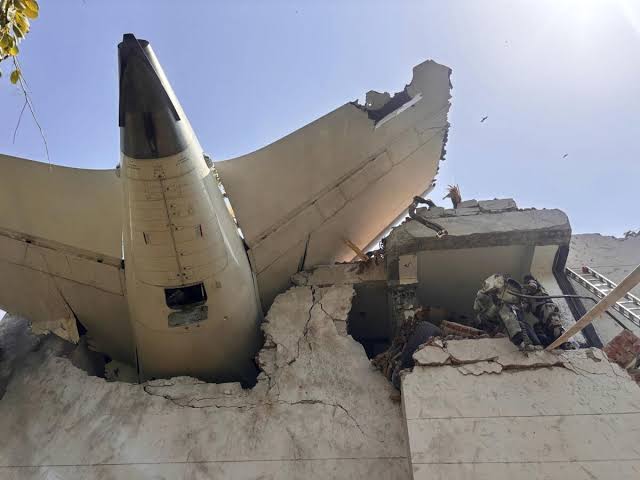
In a devastating tragedy that has shaken India and stunned the aviation world, an Air India Boeing 787 Dreamliner burst into flames and crashed shortly after takeoff from Ahmedabad on Thursday afternoon, killing 241 of the 242 people onboard. The flight, bound for London Gatwick, slammed into a student hostel near the airport, engulfing the area in fire and smoke.
The lone survivor—identified as 38-year-old British national Vishwashkumar Ramesh—was seated in an emergency exit row and managed to leap from the aircraft before it was completely consumed by fire. He is currently hospitalized and recovering from burns and fractures.
Eyewitnesses described scenes of horror as the aircraft, struggling to gain altitude, clipped the roof of a building and exploded on impact. Surveillance footage shows the jet pitching violently before crashing into the B.J. Medical College hostel, igniting a fireball visible across the city.
The victims include passengers from India, the UK, Portugal, and Canada, as well as students and staff inside the hostel. Authorities say many of the bodies were unrecognizable, and DNA identification is underway. Both of the plane’s black boxes have been recovered, and investigators from India, the U.S., and the UK have launched a joint probe into what went wrong.
Initial signs point to a possible mechanical failure during climb-out. Flight data suggests the aircraft never retracted its landing gear, and an emergency transmission was made moments before contact was lost. Boeing, which manufactures the Dreamliner, is under renewed scrutiny as this marks the first fatal crash of a 787 since its introduction.
Prime Minister Narendra Modi and leaders from around the world have offered condolences, while Air India has pledged full support to the families of the victims. As rescue operations wrap up and the investigation deepens, one question looms large: how could a routine flight end in such catastrophic loss?


