
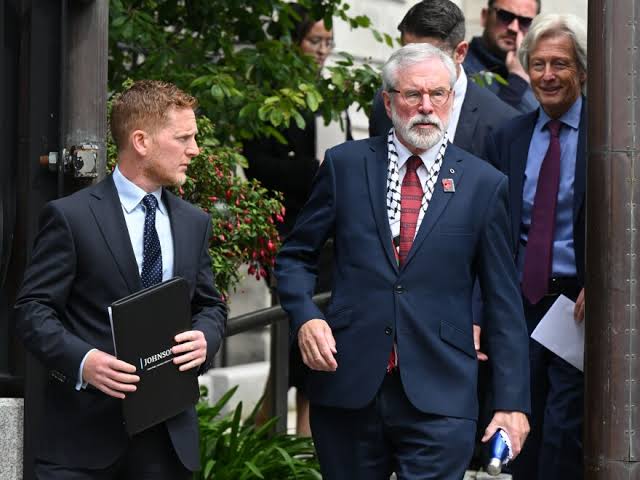
Former Sinn Féin leader Gerry Adams secured a significant legal victory in Dublin’s High Court, winning a libel case against the British Broadcasting Corporation (BBC). The court awarded Adams €100,000 (approximately £84,000) in damages, concluding that the BBC had defamed him in a 2016 documentary and accompanying online article.
The contentious BBC report alleged that Adams had sanctioned the 2006 murder of Denis Donaldson, a former Sinn Féin official who had been exposed as a British intelligence informant. Donaldson was killed in County Donegal after revealing his role as a spy. An anonymous source in the documentary claimed that Adams approved the assassination, a claim Adams vehemently denied, labeling it a “grievous smear.”
After a nearly seven-week trial and over six hours of jury deliberation, the court found that the BBC’s reporting implied Adams had approved the murder and that the broadcaster did not act in good faith or in a fair and reasonable manner. The jury rejected the BBC’s defense that the report was responsible journalism presented in the public interest.
Adams expressed satisfaction with the verdict, stating that the case was about “putting manners on the BBC.” He emphasized that the prolonged online presence of the false allegation undermined the BBC’s standards of accuracy.
The BBC expressed disappointment with the ruling, suggesting it might harm journalistic freedom, and indicated plans to carefully review the ruling before deciding whether to appeal.
The Real IRA claimed responsibility for Donaldson’s killing in 2009, and the investigation remains ongoing. Adams, who led Sinn Féin from 1983 to 2018 and played a key role in the 1998 Good Friday Agreement, has consistently denied being a member of the IRA, though past associates claim otherwise.
This case has reignited political debates over past conflicts in Northern Ireland and the UK government’s stance on legacy issues. Adams indicated any compensation awarded would go to charitable causes.
The legal battle is expected to cost the BBC between £3 million and £5 million, marking it as one of the most expensive cases the corporation has ever faced.


